

Losing multiple teeth affects far more than your smile. It changes how you eat, how you speak, and how you feel about yourself in daily life. Dentures in Chennai remain one of the most accessible and well-established ways to restore a full set of functional teeth — without surgery. At Aligning Dentistry, Alwarpet, every denture is planned by an MDS specialist and fabricated to fit precisely, look natural, and perform reliably from the first day of wear.
Dentures are removable prosthetic devices designed to replace missing teeth and the surrounding gum tissue. They restore the ability to chew, speak clearly, and maintain facial structure — all of which are progressively affected when multiple teeth are lost and left unreplaced.
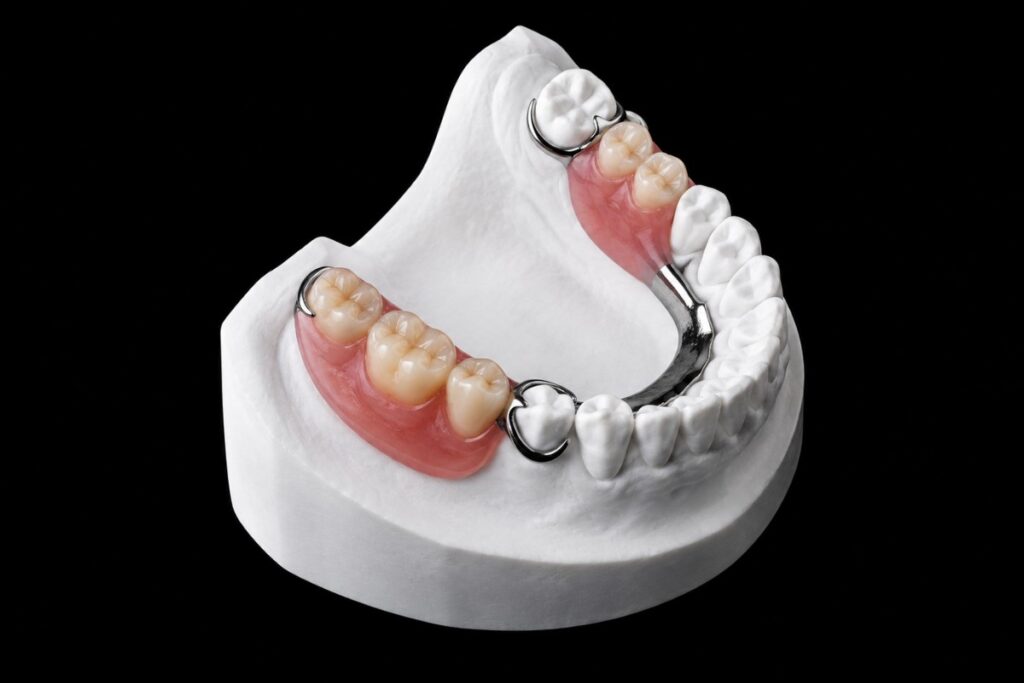
Complete dentures replace all teeth in the upper jaw, the lower jaw, or both. Partial dentures replace several missing teeth when healthy natural teeth remain and can provide support. Both types are custom-fabricated to fit the unique contours of your mouth, and shaded to match a natural tooth appearance.
Modern dentures — when properly designed and fitted — are more comfortable, more stable, and more natural-looking than older generations of the same appliance. At Aligning Dentistry, every denture is planned with careful attention to fit, bite, and aesthetics — not produced as a generic, one-size solution.
For patients considering their options, dentures are also discussed in the context of implant-supported alternatives — where implants provide a fixed foundation that eliminates the movement associated with conventional removable dentures.
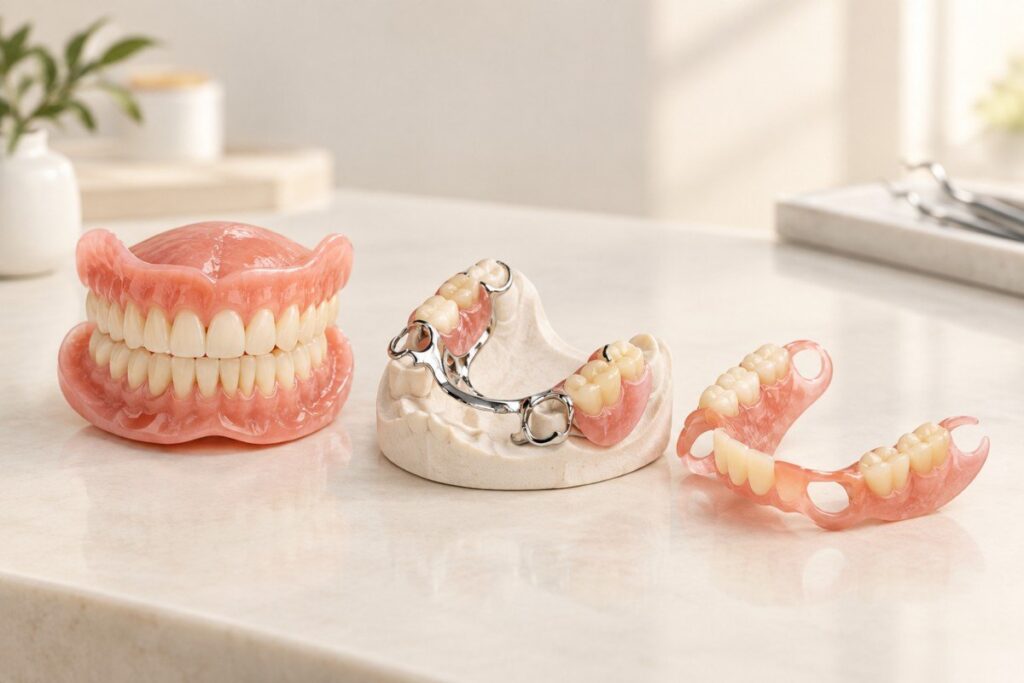
Multiple Missing Teeth Across One or Both Jaws When tooth loss is extensive and spread across the arch, individual replacements are not always practical or appropriate. Dentures offer a full-arch solution that restores both appearance and function comprehensively.
Remaining Teeth That Are Too Compromised to Save When the majority of remaining teeth have advanced decay, severe gum disease, or structural failure beyond reliable restoration, extraction followed by a complete denture is often the most clinically sound path forward.
Difficulty Chewing a Normal Diet Significant tooth loss progressively limits what you can eat — forcing adaptation toward soft, easy foods. Properly fitted dentures restore sufficient chewing function to return to a broader, more nutritionally adequate diet.
Changes in Facial Appearance Due to Tooth Loss The loss of multiple teeth causes the jawbone to resorb over time, leading to a sunken facial appearance — particularly around the cheeks and lips. Dentures restore the volume and support that teeth previously provided.
Existing Dentures That No Longer Fit Correctly Dentures fitted years ago gradually lose their fit as the jawbone changes beneath them. Poorly fitting dentures cause soreness, instability, and difficulty eating — and require either relining or replacement.
Existing Dentures That No Longer Fit Correctly Dentures fitted years ago gradually lose their fit as the jawbone changes beneath them. Poorly fitting dentures cause soreness, instability, and difficulty eating — and require either relining or replacement.
Existing Dentures That No Longer Fit Correctly Dentures fitted years ago gradually lose their fit as the jawbone changes beneath them. Poorly fitting dentures cause soreness, instability, and difficulty eating — and require either relining or replacement.
Restores the Ability to Eat and Speak Normally The most immediate impact of well-fitted dentures is functional — the ability to chew food properly and speak without the distortion or mumbling that significant tooth loss causes. This affects daily quality of life directly and immediately.
Maintains Facial Structure and Appearance Teeth support the muscles of the cheeks and lips. Dentures replace this support — preventing the progressive facial collapse that occurs when multiple teeth are missing and unreplaced for an extended period.
A Non-Surgical Option for Full Tooth Replacement For patients who cannot undergo implant surgery — due to insufficient bone, medical conditions, or personal preference — dentures provide a complete tooth replacement solution that requires no surgical procedure.
Custom-Made for a Natural Appearance Modern denture teeth are selected and arranged to mimic natural dentition in shape, size, and colour. A well-made denture, fitted by a specialist, should not look artificial to others in normal social interaction.
Affordable and Accessible Tooth Replacement Compared to implant-supported restorations, conventional dentures provide a more accessible entry point for full tooth replacement — allowing patients to restore function and appearance without the cost or time commitment of surgical treatment.
Implant Support Can Be Added Later Conventional dentures and implant-supported dentures are not mutually exclusive. Patients who begin with conventional dentures can transition to implant-supported options at a later stage if bone and circumstances allow.
Initial Consultation and Assessment Your specialist reviews your dental and medical history, assesses the current state of your remaining teeth and gums, and discusses your suitability for complete or partial dentures. The option of implant-supported dentures is raised where clinically relevant.
Extractions and Healing (Where Required) If remaining teeth require extraction before denture fabrication, this is completed first, with healing time allowed before impressions are taken. In some cases, immediate dentures are provided to avoid a gap during healing.
Impressions and Jaw Relationship Recording Precise impressions of your upper and lower ridges are taken, along with records of how your jaws relate to each other. This information is sent to the dental laboratory as the foundation of your custom denture fabrication.
Try-In and Adjustments A trial denture is fitted before the final version is completed — allowing your specialist to assess the fit, bite, appearance, and tooth position while there is still opportunity to make adjustments before the restoration is finalised.
Final Fitting and Follow-Up The completed denture is fitted, and bite and comfort are confirmed. Initial adjustment appointments are scheduled as needed — because even well-made dentures often require minor refinements in the first few weeks of wear as your mouth adapts.
MDS Prosthodontist — Specialist in Removable and Fixed Restorations Denture planning and fitting at our clinic is overseen by an MDS-qualified prosthodontist — a specialist with dedicated postgraduate training in tooth replacement, bite relationships, and removable prosthetics. The difference in fit, function, and appearance is significant compared to generalist provision.
Custom Fabrication — Not Off-the-Shelf Every denture at Aligning Dentistry is custom-made to the specific anatomy of your mouth. Shade selection, tooth arrangement, and bite registration are all carried out by a specialist — not delegated or approximated.
Honest Discussion of All Options Where implant-supported dentures or other fixed alternatives are clinically appropriate and within the patient's consideration, we discuss these openly — so your decision is made with a complete understanding of what is available to you.
Careful Attention to Fit and Comfort The most common complaint with dentures is poor fit — leading to movement, soreness, and restricted use. We invest time in impression accuracy, jaw recording, and follow-up adjustments to ensure the fit is as stable and comfortable as possible.
Immediate Denture Options Available For patients who need to avoid being without teeth during the healing period following extractions, immediate dentures can be planned and discussed during your assessment appointment.
Conveniently accessible for patients from Alwarpet, Mylapore, T. Nagar, Adyar, and Nungambakkam — with a specialist standard of care that matches the importance of the treatment.
Our experts understand that dentures represent a significant adjustment — and approaches every case with the time and precision required to deliver a result that patients can wear with confidence from the outset.
Dentures cost in Chennai varies depending on the type of denture, the materials used, and the complexity of your individual case. A reliable cost figure can only be provided after a proper clinical assessment.
A complete denture replacing all teeth in one arch differs in scope and cost from a partial denture replacing selected missing teeth alongside remaining natural teeth.
Acrylic, flexible, and metal-based partial denture frameworks carry different costs. Material selection is based on durability, fit requirements, and aesthetic priorities.
If teeth need to be removed before the denture is made, this forms part of the overall treatment plan and cost.
Immediate dentures, placed on the day of extraction, require additional planning and often a subsequent reline appointment as healing progresses.
Dentures fabricated by high-quality dental laboratories with careful shade and anatomy standards carry a higher cost than those produced by lower-tier facilities, and deliver noticeably better outcomes.
A clear, itemised cost estimate for dentures in Chennai is provided at your consultation — once your specialist has assessed your mouth and confirmed what your situation requires.
For patients who have lived with significant tooth loss, a well-fitted denture can be genuinely life-changing. Here is what some of our patients have shared.
Dentures are removable prosthetic appliances that replace missing teeth and surrounding gum tissue. They are recommended for patients who have lost multiple teeth — either through decay, gum disease, trauma, or extraction — and require a non-surgical full or partial replacement solution.
Complete dentures replace all teeth in the upper jaw, lower jaw, or both. Partial dentures replace several missing teeth when healthy natural teeth remain in the arch and can serve as support. Your specialist will determine which type is appropriate based on the number and position of remaining teeth.
From initial consultation to final fitting, conventional dentures typically require multiple appointments over several weeks. If extractions are needed first, additional healing time is required before impressions can be taken. Your specialist will outline a realistic timeline at your consultation.
New dentures require an adjustment period — typically a few weeks — during which the muscles of the cheeks, tongue, and lips adapt to the presence of the appliance. Initial minor soreness is common and is addressed at follow-up appointments. A well-fitted denture should not cause ongoing pain.
Dentures are removable appliances that rest on the gum ridge. Dental implants are surgically placed into the jawbone and support fixed restorations. Implants do not move, do not require removal, and preserve jawbone more effectively — but involve surgery and a higher cost. Both options are discussed openly at your consultation.
Most patients adapt to eating a broad diet with well-fitted dentures, though particularly hard or sticky foods require ongoing caution. Chewing function improves significantly as you adapt to the appliance. Implant-supported dentures offer greater stability for patients who want a more confident eating experience.
Yes. Implant-supported dentures use two to four implants in the jaw to provide a secure, stable foundation for the denture — significantly reducing movement during eating and speaking. This option is discussed where clinically appropriate and within the patient’s consideration.
Dentures should be removed at night to allow the gum tissue to rest, cleaned daily with a soft brush and denture-specific cleaning solution, and stored in water when not being worn. Avoid hot water, which can warp the acrylic. Regular professional check-ups are important for monitoring fit and gum health.
Yes — a well-designed denture, fabricated with careful shade selection and natural tooth arrangement, should not look artificial in normal social interaction. At Aligning Dentistry, denture aesthetics are planned by an MDS prosthodontist, not approximated from a catalogue.
As the jawbone resorbs over time following tooth loss, existing dentures gradually lose their fit. Loose or uncomfortable dentures can be relined — adjusted to conform to the changed ridge shape — or replaced if the material has aged beyond reliable adjustment. Do not continue wearing an ill-fitting denture.
Yes. Removing dentures overnight allows the gum tissue to recover and maintains better oral hygiene. Wearing dentures continuously without rest increases the risk of gum soreness and fungal infection beneath the appliance.
With proper care, a well-made denture typically lasts several years before replacement is required. However, the fit will gradually change as the jawbone resorbs — requiring periodic relining or adjustment to maintain comfort and function.
Tooth loss does not have to mean living with restriction — in what you eat, how you speak, or how you feel about your smile.
At Aligning Dentistry, Alwarpet, our MDS prosthodontists fit dentures in Chennai with the specialist precision, custom fabrication, and honest clinical guidance that makes the difference between a denture you tolerate and one you wear with confidence. Book a consultation and let’s assess what your situation requires.
Schedule your consultation with an MDS specialist today.
Prefer to message first? Reach us on WhatsApp for a quick, no-pressure conversation.
Speak directly with our team to ask questions or confirm availability.