
Some jaw and bite problems originate not in the teeth, but in the bones of the upper or lower jaw themselves. For these cases, corrective jaw surgery in Chennai — also known as orthognathic surgery — is the treatment that addresses the root cause. At Aligning Dentistry, Alwarpet, this is managed by MDS oral and maxillofacial specialists working in close coordination with our orthodontic team — ensuring your surgical and post-surgical care is fully integrated.
Corrective jaw surgery, clinically referred to as orthognathic surgery, is a surgical procedure that repositions the upper jaw (maxilla), the lower jaw (mandible), or both — to correct skeletal discrepancies that affect how the teeth bite together, how the face looks, and how the jaw functions.
Unlike braces or aligners, which move teeth within the bone, orthognathic surgery moves the bone itself. This makes it the appropriate treatment when the underlying jaw position is the cause of the problem — not the teeth alone.
Corrective jaw surgery is typically planned in close collaboration between an oral and maxillofacial surgeon and an orthodontist. Braces or aligners are usually worn before and after surgery to ensure the teeth are correctly aligned to the newly repositioned jaw.
Patients who need this treatment often have conditions that affect chewing, speech, breathing, and facial symmetry — issues that have frequently been present since childhood or adolescence and have not resolved with growth.
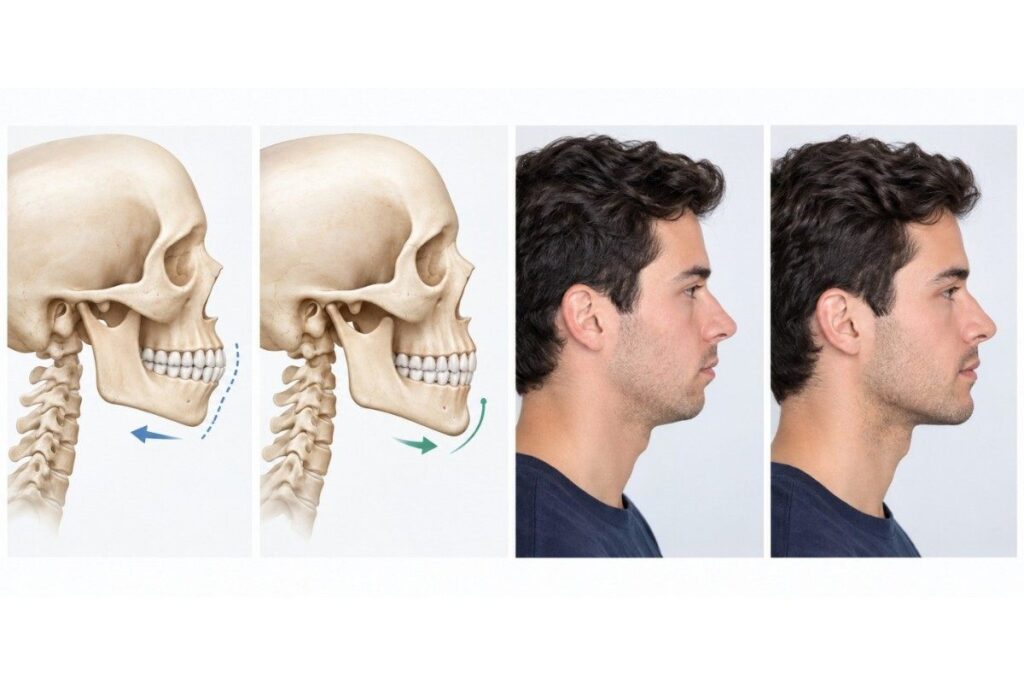
Significant Overbite or Underbite That Braces Cannot Fully Correct When the upper or lower jaw is positioned too far forward or too far back relative to the other, the degree of skeletal discrepancy may exceed what orthodontic treatment alone can address.
Difficulty Chewing or Biting Food Properly If you find it consistently difficult to chew certain foods, or if your back teeth meet but your front teeth don’t (open bite), this may indicate a jaw position problem rather than a tooth alignment problem.
Chronic Jaw Pain or Temporomandibular Joint (TMJ) Issues Jaw joint pain, clicking, or dysfunction that persists despite conservative treatment can sometimes be linked to an underlying skeletal discrepancy that corrective surgery would address.
Sleep Apnoea Related to Jaw Position In some patients, the position of the lower jaw contributes to airway obstruction during sleep. Corrective jaw surgery can be part of a multidisciplinary treatment plan for jaw-related sleep apnoea.
Facial Asymmetry If one side of your face appears noticeably different from the other — particularly in the lower face and jaw area — skeletal asymmetry may be the cause, and surgical correction may restore facial balance.
Mouth Breathing and Speech Difficulties Persistent mouth breathing or speech issues that haven’t resolved with orthodontic or speech therapy may have a structural cause related to jaw position.
An Orthodontist Has Recommended Surgical Assessment If a previous orthodontist has told you that your bite problem is beyond what braces can fully correct, a surgical assessment is the appropriate next step — not a second opinion on continuing with braces alone.
Addresses the Root Cause, Not Just the Symptoms Corrective jaw surgery repositions the bone — resolving discrepancies that no amount of tooth movement can compensate for. The result is a stable, functional bite achieved at the structural level.
Improved Bite Function and Chewing Patients who have struggled with chewing efficiency or inconsistent bite contact often experience significant functional improvement after surgery — directly impacting daily quality of life.
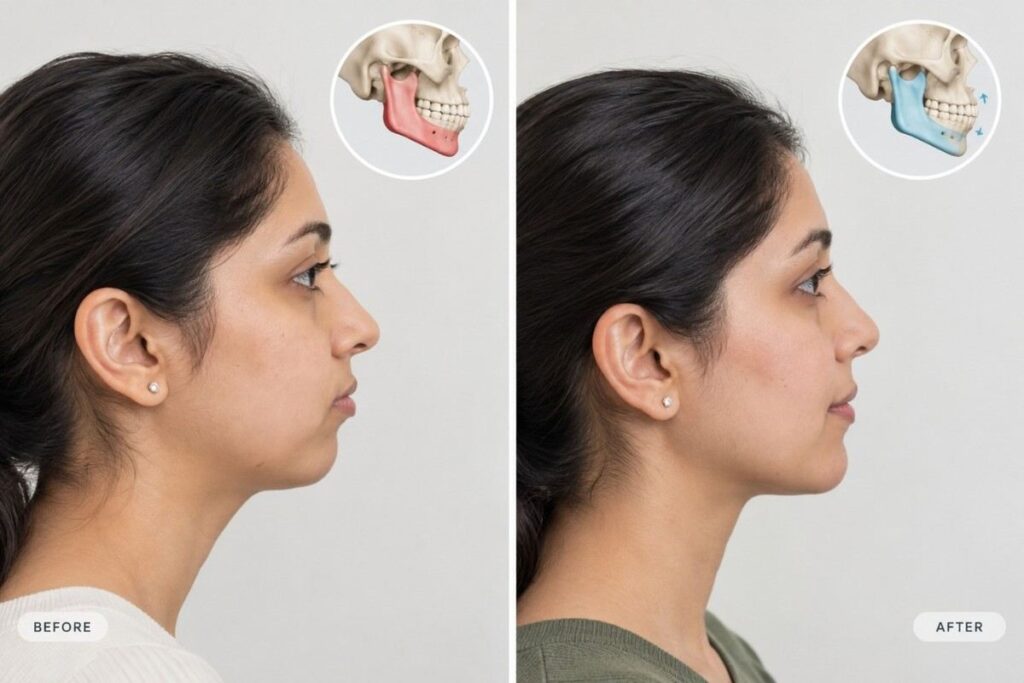
Facial Balance and Symmetry Repositioning the jaws also changes the soft tissue profile of the face. Many patients notice improved facial proportions and symmetry as a direct result of correcting the underlying skeletal structure.
Because surgery addresses the bone position rather than compensating through tooth movement, results tend to be highly stable when combined with appropriate orthodontic treatment before and after the procedure.
Potential Improvement in Breathing and Sleep For patients whose jaw position contributes to airway narrowing, corrective jaw surgery can support better breathing patterns — with meaningful quality of life benefits beyond the dental.
At Aligning Dentistry, surgical planning is closely coordinated with your orthodontic treatment — ensuring the teeth and jaws arrive at their final positions in a planned, predictable sequence.
Specialist Consultation Your initial appointment involves a detailed discussion of your concerns, symptoms, and history. Your specialist reviews any previous orthodontic records and carries out a clinical assessment of your bite, jaw relationship, and facial profile.
Comprehensive Diagnostic Records Full diagnostic records are taken — including dental X-rays, a lateral cephalometric radiograph (a specific side-profile X-ray used for jaw analysis), intraoral scans, facial photographs, and in some cases, a 3D CBCT scan. These records form the foundation of your surgical plan.
Combined Orthodontic and Surgical Planning Your case is planned collaboratively between the oral surgeon and orthodontist. Pre-surgical braces or aligners are prescribed to align the teeth to their correct position within each jaw before surgery. Digital surgical planning tools may be used to simulate the procedure and predicted outcome.
Surgery Corrective jaw surgery is performed under general anaesthesia in a hospital setting. The jaw bones are carefully repositioned and secured using small titanium plates and screws. The procedure is carried out entirely inside the mouth — no external scarring.
Post-Surgical Recovery and Orthodontic Completion Recovery involves a period of dietary modification and follow-up appointments to monitor healing. Once the surgical result has stabilised, your orthodontist completes the final tooth alignment. Retainers are then provided to maintain the outcome long term.
Fully Integrated Orthodontic-Surgical Care Because we have both orthodontic and surgical specialists under one roof, your pre-surgical and post-surgical orthodontic treatment is coordinated directly with your surgical plan — not managed separately across different providers.
Specialist Oral and Maxillofacial Surgeon Corrective jaw surgery at our clinic is performed by an MDS-qualified oral and maxillofacial surgeon — a specialist trained specifically in surgical procedures of the jaw, face, and related structures.
Advanced Digital Surgical Planning We use digital planning technology to analyse jaw relationships and simulate surgical outcomes before the procedure — improving precision and giving you a clearer picture of expected results.
Continuity of Care Throughout Treatment From your first consultation through to final retainers, your care is managed consistently by the same specialist team — so nothing falls between the gaps.
Transparent, Unhurried Consultations Corrective jaw surgery is a significant decision. We take the time needed to explain the full treatment journey, answer every question, and ensure you’re making a fully informed choice — without pressure.
Accessible to Patients Across South Chennai Our clinic in Alwarpet is conveniently located for patients from Mylapore, T. Nagar, Adyar, Nungambakkam, and beyond — with a premium standard of care that matches the complexity of the treatment.
Corrective jaw surgery at Aligning Dentistry is led by Qualified Specialists — an oral and maxillofacial surgeon with specialist training and clinical experience in orthognathic surgery, jaw reconstruction, and complex facial skeletal correction.
Dr. N. Subash Chandar MDS (Orthodontics & Dentofacial Orthopaedics, INVISALIGN Clear Aligner Specialist) works closely with our orthodontic team to ensure every surgical case is supported by a complete, coordinated treatment plan — from first consultation through to final orthodontic finish.
Corrective jaw surgery cost in India varies considerably — and any estimate given without a full clinical assessment is unreliable. The investment depends on multiple clinical and logistical factors.
Single jaw surgery (upper or lower only) differs in complexity and cost from bimaxillary surgery, which repositions both jaws simultaneously.
Braces or aligners worn before surgery are part of the total treatment investment and can span 12–18 months.
As surgery is performed under general anaesthesia in a hospital, these form a significant component of the overall cost.
Final tooth alignment after healing adds to the total treatment timeline and cost.
3D imaging and digital surgical planning contribute to precision and form part of the pre-treatment investment.
Because this is a multi-stage treatment involving both surgical and orthodontic phases, a transparent, itemised cost breakdown is provided at your consultation — after your specialist has reviewed your records and confirmed your surgical plan.
Corrective jaw surgery is a major decision — and for many patients, getting the right information and the right team made all the difference.
Corrective jaw surgery, or orthognathic surgery, repositions the upper jaw, lower jaw, or both to correct skeletal discrepancies that affect bite function, facial balance, and sometimes breathing. It is recommended when the jaw bone position itself — not just the teeth — is the source of the problem.
The procedure is performed under general anaesthesia, so there is no pain during surgery. Post-operative discomfort, swelling, and jaw stiffness are expected in the recovery period and are managed with prescribed medication. Most patients find recovery more manageable than anticipated.
Initial recovery typically involves 2–4 weeks of dietary restriction (soft or liquid foods) and reduced activity. Swelling gradually resolves over several weeks to months. Full bone healing and final orthodontic completion may take 6–12 months post-surgery.
In most cases, yes. Pre-surgical orthodontic treatment aligns the teeth correctly within each jaw before surgery. Post-surgical orthodontic treatment completes the final bite alignment once the jaws have healed in their new position.
Corrective jaw surgery cost in India depends on whether one or both jaws are involved, the duration of pre and post-surgical orthodontic treatment, hospital and anaesthesia fees, and diagnostic planning costs. A complete, itemised estimate is provided after your specialist consultation.
Corrective jaw surgery is performed entirely through incisions inside the mouth — there are no external cuts or visible scars on the face.
The total treatment journey — including pre-surgical braces, surgery, recovery, and post-surgical orthodontic completion — typically spans 18–30 months depending on case complexity. Your specialist will outline a realistic timeline at your consultation.
Yes, in most cases. Repositioning the jaw bones changes the soft tissue profile of the face — often improving facial balance, chin projection, and overall proportions. Digital planning allows your specialist to show you the predicted facial changes before you commit to treatment.
Orthognathic surgery is a well-established procedure with a long clinical track record when performed by a qualified oral and maxillofacial surgeon. As with any surgery under general anaesthesia, risks exist and are discussed in full during your consultation.
In selected patients where the jaw position contributes to airway narrowing, corrective jaw surgery can be part of a treatment plan for obstructive sleep apnoea. This is assessed as part of a broader multidisciplinary evaluation.
Non-surgical jaw correction uses orthodontic appliances and aligners to manage mild to moderate bite discrepancies without surgery. Corrective jaw surgery is indicated for skeletal discrepancies that are beyond the scope of orthodontic treatment alone. Your specialist will determine which is appropriate for your case.
Jaw surgery is generally performed after jaw growth is complete — typically after age 17–18 for females and 18–21 for males. Operating before growth is complete risks relapse as the jaw continues to develop.
Some bite problems need more than braces. Some need a specialist, a plan, and the right surgical team.
At Aligning Dentistry, Alwarpet, our MDS specialists provide corrective jaw surgery in Chennai with the full coordination of orthodontic and surgical care — from your first consultation to your final retainer. Take the first step with a proper assessment.
Schedule your consultation with an MDS specialist today.
Prefer to message first? Reach us on WhatsApp for a quick, no-pressure conversation.
Speak directly with our team to ask questions or confirm availability.