

A cavity left untreated does not stay the same size. It progresses — deeper into the tooth, closer to the nerve, and eventually beyond what a filling can address. Tooth filling in Chennai at Aligning Dentistry, Alwarpet stops decay at the right stage, restores the tooth with material matched to its natural colour, and ensures the restoration fits and functions correctly from day one.
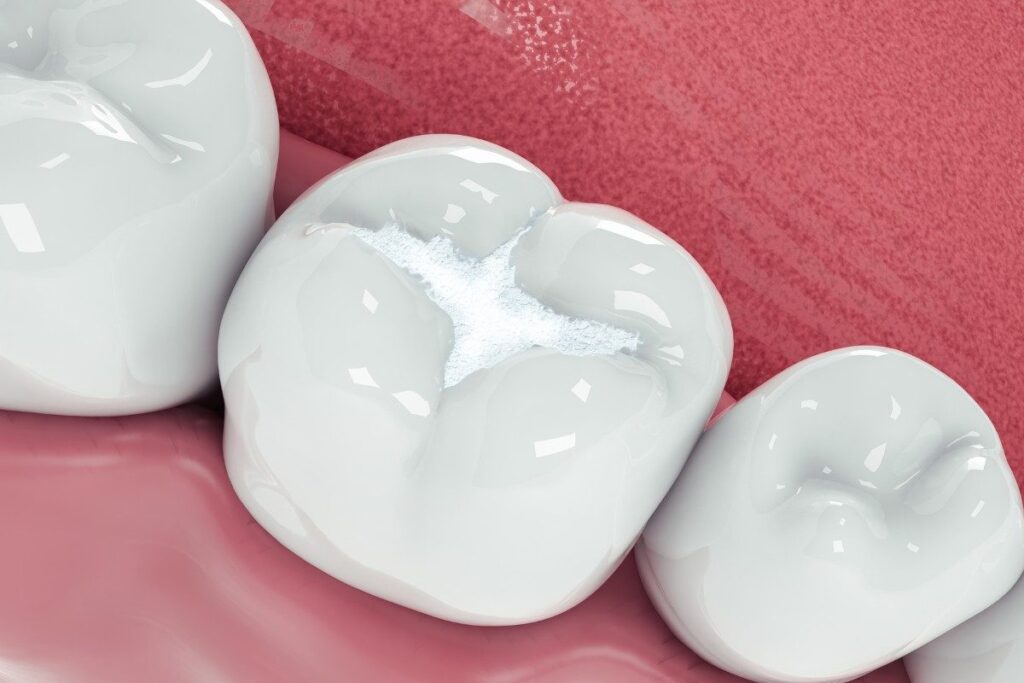
A tooth filling is a restorative procedure that removes decayed or damaged tooth structure and replaces it with a durable material — restoring the tooth’s shape, strength, and function. It is the most common restorative dental procedure and, when carried out at the right time, one of the most effective ways to preserve a natural tooth long term.
At Aligning Dentistry, we use tooth-coloured composite resin as our primary filling material — a material that bonds directly to the tooth structure, requires less removal of healthy tooth than older amalgam fillings, and produces a result that is visually indistinguishable from the surrounding enamel.
Fillings are not only for visible cavities. Early-stage decay detected on an X-ray — before it causes symptoms — is far easier and less invasive to treat with a filling than decay that has progressed to the nerve. This is one of the clearest arguments for regular dental check-ups: catching decay early means a smaller filling, a faster procedure, and a tooth that remains stronger.
For teeth where the filling would be extensive, your specialist will discuss whether a crown is a more appropriate restoration — because a filling that occupies too much of a tooth’s structure can compromise its long-term integrity.

Sensitivity that lingers after the stimulus is removed — particularly to cold or sweet — is often an early indicator of decay reaching the inner layers of the tooth. A filling at this stage prevents progression toward the nerve.
Visible discolouration or a cavity you can see or feel with your tongue is a clear indicator that decay is present. These cases have typically progressed beyond the earliest stage and require prompt treatment.
Discomfort that is spontaneous, provoked by biting, or dull and ongoing around a tooth may indicate that decay is closer to or affecting the pulp. This warrants urgent assessment — it may still be addressable with a filling or may require root canal treatment depending on depth.
consistently packing between specific teeth often indicates a cavity developing at the contact point between teeth — a common location for decay that is not visible to the naked eye but detectable on X-ray.
do not last indefinitely. Old amalgam fillings that are cracking, leaking at the margins, or no longer sealing the tooth correctly allow bacteria to re-enter beneath the filling. Replacement with a modern composite restores the seal and appearance.
Many cavities at their earliest stage cause no symptoms at all. Routine dental X-rays detect decay between teeth or beneath existing restorations before it becomes painful — allowing a smaller, simpler filling rather than a larger procedure later.
Minor chips and surface fractures — even without decay — can be restored with composite material, restoring the tooth’s shape and preventing the sharp edge from causing further damage or discomfort.
The most important function of a filling is what it prevents. Removing the decayed tissue and sealing the tooth stops the decay process in its tracks — protecting the nerve, the root, and the surrounding bone from what would otherwise be inevitable progression.
Composite resin bonds adhesively to the tooth, meaning less healthy enamel and dentine needs to be removed compared to older filling materials. The result is a tooth that retains more of its original strength alongside the restoration.
Tooth-coloured composite fillings are shade-matched to the surrounding tooth — blending seamlessly into the natural dentition. There is no visible grey or silver, and most patients find their filled teeth are completely undetectable to others.
Decay and cavities cause sensitivity and discomfort that can alter how you chew — creating an imbalance that affects neighbouring teeth and the jaw over time. A well-placed filling restores comfortable, even function immediately.
In most cases, a tooth filling is completed in a single appointment. This makes it one of the most time-efficient dental treatments available — particularly when decay is caught early and the filling is correspondingly straightforward.
Consultation and Examination Your specialist examines the tooth clinically and reviews X-rays to confirm the presence, extent, and depth of decay. If multiple teeth show early decay, a treatment sequence is discussed — prioritising teeth where decay is most advanced or most at risk of progressing.
Decay Assessment and Confirmation The depth of the cavity is assessed to confirm that a filling is the appropriate treatment. If decay has reached or is very close to the nerve, root canal treatment may be discussed as a necessary first step before restoration.
Shade Selection and Treatment Planning For visible teeth, the composite shade is selected to match the surrounding enamel under consistent lighting. Your specialist confirms the plan, the material to be used, and the expected outcome before beginning the procedure.
Decay Removal and Filling Placement Local anaesthesia is administered where needed. The decayed tissue is removed precisely, the cavity is prepared, and composite resin is placed in incremental layers — each layer cured with a light before the next is applied. The filling is then shaped and polished to match the natural tooth contour and surface texture.
Bite Check and Post-Procedure Guidance The bite is checked carefully to ensure the filling does not create a high point that causes discomfort. Post-procedure sensitivity — if present — is typically mild and resolves within a few days. You are advised on when to eat, what to avoid immediately after, and how to maintain the restoration long term.
Specialist Assessment — Not Just a Quick Fix At Aligning Dentistry, a filling appointment begins with a proper clinical assessment — not just a visual check and drill. The extent and depth of decay is confirmed before treatment begins, and the decision between a filling, a crown, or a root canal is made on clinical grounds, not convenience.
Tooth-Coloured Composite as Standard We use high-quality composite resin for all fillings — providing a natural appearance, a strong bond to the tooth, and a material that requires minimal removal of healthy tooth structure. Amalgam is not used at our clinic.
Precise Shade Matching for Natural Results Composite is available in a wide range of shades and translucencies. We select the closest match to your natural tooth under consistent lighting — so the filling integrates visually with the surrounding enamel, not just approximated.
Decay Detection Beyond the Visible Routine X-rays and clinical probing allow us to identify decay that is not yet symptomatic or visible — giving you the opportunity to treat it with a smaller, simpler filling before it becomes a more complex and costly problem.
Long-Term View on Restoration Decisions We consider the long-term structural integrity of the tooth when planning a filling. If the cavity is large enough that a filling would leave the tooth vulnerable to fracture, we will recommend a crown instead — and explain clearly why that decision serves your tooth better over time.
Located in Alwarpet, Accessible Across South Chennai Conveniently positioned for patients from Alwarpet, Mylapore, T. Nagar, Adyar, and Nungambakkam — with a standard of restorative care that takes even a routine filling seriously.
Tooth fillings at Aligning Dentistry are performed by [Doctor Name], MDS — a restorative specialist with postgraduate clinical training and extensive experience in tooth-coloured composite restorations, cavity management, and conservative dental treatment.
Teeth filling cost in Chennai varies depending on the size and location of the cavity, the material used, and the complexity of the restoration. A reliable estimate requires a clinical examination and X-ray.
A small early-stage cavity requires less material and time than a large or deep restoration involving multiple surfaces of the tooth.
Fillings on back teeth that bear significant chewing forces require more material and careful contouring than front tooth restorations.
A cavity affecting one surface of a tooth costs less than a restoration spanning two or three surfaces.
Replacing an old failing filling involves removal of the previous material, which adds to the clinical time involved.
High-quality composite resin selected for shade accuracy and durability reflects in the cost compared to basic materials.
A clear cost estimate for tooth filling in Chennai is provided at your consultation — once your specialist has assessed the tooth and confirmed what the restoration requires.
A filling done well is something most patients forget about within days — because it simply becomes part of the tooth. Here is what some of our patients experienced.
Tooth filling is performed under local anaesthesia for deeper cavities, making the procedure comfortable. Very small, shallow fillings may not require anaesthesia at all. Any post-procedure sensitivity is typically mild and resolves within a few days.
Most tooth fillings are completed in a single appointment lasting between 30 and 60 minutes, depending on the size and location of the cavity. Multiple fillings in the same session may take longer.
With proper oral hygiene and regular professional check-ups, high-quality composite fillings typically last many years. Longevity depends on the size of the filling, the tooth’s position, and how well the tooth is maintained.
Composite resin is tooth-coloured, bonds directly to the tooth requiring less removal of healthy structure, and produces a natural appearance. Amalgam is a silver-grey metal alloy. At Aligning Dentistry, we use composite resin as standard — amalgam is not placed at our clinic.
Yes, though it is not common in well-placed fillings. A filling may dislodge if it was not bonded correctly, if the tooth experienced significant force, or if decay developed beneath or around it. If a filling feels loose or comes out, contact us promptly to avoid exposing the tooth to further damage.
Yes — many cavities cause no symptoms in their early stages. Pain typically indicates decay has progressed closer to the nerve, at which point a simple filling may no longer be sufficient. Early treatment with a small filling is far preferable to waiting until the tooth becomes symptomatic.
Decay progresses steadily without treatment — from enamel into dentine, and eventually toward the pulp (nerve). What begins as a small filling becomes a root canal and crown, or eventually an extraction. Early treatment is always simpler, less invasive, and less costly.
No — composite resin is shade-matched to your natural tooth colour. A well-placed composite filling in a back tooth is effectively invisible, and in a front tooth should be indistinguishable from the surrounding enamel under normal lighting.
Composite fillings are maintained like natural teeth — regular brushing, flossing, and routine professional cleaning. Avoid biting very hard objects directly on the filled tooth, and attend regular check-ups so the filling’s condition can be monitored over time.
Yes. Old amalgam fillings that are cracking, leaking, or simply cosmetically unacceptable can be replaced with composite resin — restoring a natural appearance and resealing the tooth. Your specialist will assess whether replacement is clinically indicated or purely elective.
Not always. When the cavity is very large and the filling would occupy a significant proportion of the tooth’s structure, a crown provides better long-term protection — encasing the remaining tooth walls rather than relying on them to hold the filling in place. Your specialist will recommend the restoration that serves the tooth best over time.
With composite resin fillings, the material is hardened immediately with a curing light during placement — so you can eat shortly after the anaesthetic wears off. Avoid very hard or sticky foods on the filled tooth for the first 24 hours as a precaution.
A cavity is not something that resolves on its own — but caught early, it is one of the simplest problems in dentistry to fix.
At Aligning Dentistry, Alwarpet, our MDS specialists place tooth fillings in Chennai with the precision, shade accuracy, and clinical care that turns a routine procedure into a restoration that lasts. Book a consultation and let us assess what your tooth needs.
Schedule your consultation with an MDS specialist today.
Prefer to message first? Reach us on WhatsApp for a quick, no-pressure conversation.
Speak directly with our team to ask questions or confirm availability.